Friday, 25 February 2011

Repeat Patterns I Tried To Recreate

I tried to recreate the repeat patterns that I decided to look at and use for ideas for a final piece.

This is a sphere made out of paper i was looking at how to construct it into a 3D object and wrapping thin sheets of paper was the easiest way I could think of to produce that.

The second repeat pattern are arrows I looked at how to make a curved arrow instead of a straight one so as to lean them up against each other like in the picture below.

I think these work well even though though they are miniture versions of what I have looked at and I intend to take them into my final piece.

Thursday, 24 February 2011

Repetitive Patterns 3

Kitchen Tiles
Kitchen Towl
A Chair
Kitchen Floor Tiles
Coloured Glass Squares

Repetitive patterns 2

A sphere is the most repetitive pattern there is. It is the same all round a perfect shape.

It is perfectly symmetrical.
It has no edges or vertices (corners)
All points on the surface are the same distance from the center.
The most typical way to use paper to make a sphere wud be to keep lapping it over itself until it became round then shave of the imperfections to smooth the serface in other cases to screw up a piece of paper would start a sphere.
You can use all different media to make a sphere like with elastic bands. also in winter snow is used to create snowballs which are generally crafted into a sphere shape.

The sphere is used also for competitive sports e.g Football, Tennis, Golf, Volley Ball.


Of all the shapes, a sphere has the smallest surface area for a volume. Or put another way it can contain the greatest volume for a fixed surface area. The sphere appears in nature whenever a surface wants to be as small as possible. Examples include bubbles and water drops.

Repetitive Patterns 1

An arrow usually consists of a shaft with an arrowhead attached to the front end, with fletchings and a nock at the other. More recently the arrow has been a symbol of direction. It is a very simple design and is used in everyday life for motorists.


I like this graffiti design of a 3D arrow with smaller arrows coming off it. It looks effective with just one simple shape, a simple pattern used in a repetitive way.

The arrow can also be used as a repeat pattern in the picture above it makes a circle and could also be called a cycle.

Friday, 18 February 2011

Quick Experimentations

A few experimentations after the skills workshops carrying on with paper and using the folding technique mostly.

The image above and below was the only one that I used UHU glue on to connect the paper together. 

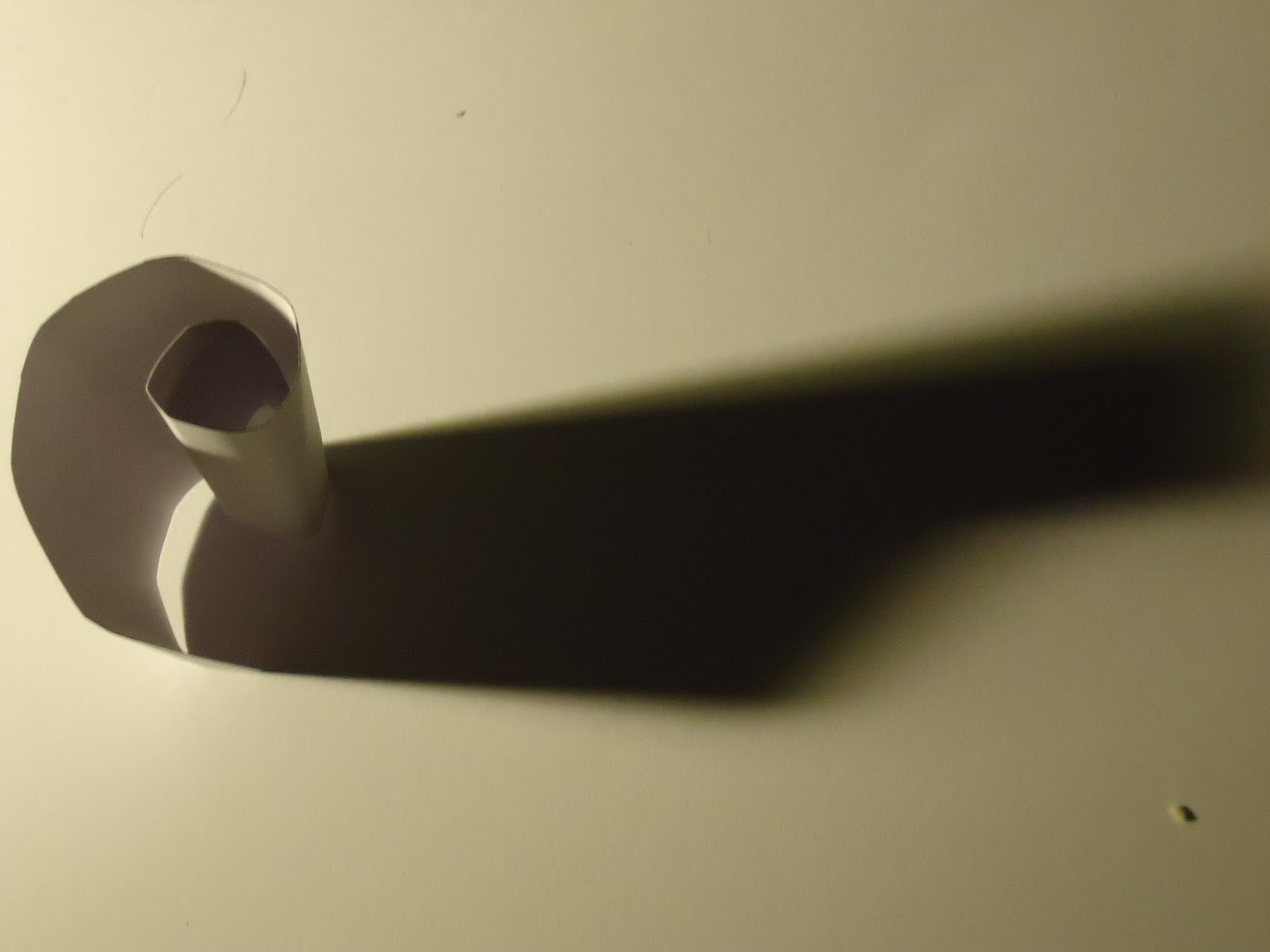
I used the shadows to show off the 3D sculptures more to give them a more graphic look.


These where very quick sculptures that were just carrying on after the workshops.

Thursday, 17 February 2011

Haruki Nakamura

Haruki Nakamura is an expert in Origami, a Japanese art that consists of creating figures by folding pieces of paper. What’s interesting about Origami is that no glue or staples are used in order to make these figures; they are created using nothing but folds.
Haruki Nakumura's work is very similar to Bert Simons work its similar to a jigsaw all the pieces fit together wheather its folded or glued together.

I like this work because Its very creative and the end product looks visually stunning. I also like how Its put together with just folds and nothing else It shows a lot of patience and skill.

Tuesday, 15 February 2011

Paper Workshop 2 & 3

In workshops two and three to me started to cut out more and use scalpels to get more unique and abstract sculptures. The sculptures below were all cut witha scalpel and with some I used masking tape. I think in these workshops we had more freedom to do what we wanted and use what we wanted.


With this sculpture I wanted to make it stand up instead of having it lying down like so many of my others i folded back and forth to create a fan effect and then bent it in the middle with it not quite up right and lobsided it gives a tower of pisa aspect.


With this paper model I was going for a repetitive image with cut out squares almost like windows and the folded in and out folds make it similar to a building.


I started to get more used to making paper models in workshops two and three and think these are a lot stronger than the first workshop models maybe because i was able too use more equipment and experiment more.